Birthday Fundraiser

Thursday, June 28, 2012

Linguistic Musings


When teaching English, it can be really interesting to see how non-English-speakers hear and think about the language. When you don't know a language well, you become very creative in the way you use it. 

Here are some superb new words and phrases that I learned, for example, while grading final exams at the university: 

"Himselvely" = By himself 
"Talk the brag" = Brag
"Steal man" = Thief 

Is it just me, or would you also love to incorporate some of these words into your everyday vocabulary? You know, you have to know a thing or two about English grammar and conventions to develop these. Actually, it takes a lot of creativity to come up with this stuff!  

Now, on a somewhat related note, I have a fun little game for you: 

When tutoring the National Cycling Team of Rwanda in English, I asked them, in groups, to make a list of words that start with a particular letter. I was particularly entertained by the "P" group. This game is called, "What Did They Mean?" What do you think these words were meant to be? 

1. Poleche 
2. Porbureme
3. Pepo
4. Penebara
5. Porgeht 
6. Phalmoce
7. Pecha 

So that I can put a little space between the questions and answers, let me give some helpful advice. For speakers of Kinyarwanda, and many African languages for the matter, it's extremely common to mix up the R and the L. In fact, it is often acceptable to interchange these letters in Kinyarwanda (and Luganda, etc.) words. In  other words, both spellings can be acceptable. This is funny because in American English, R and L are totally distinct sounds. But for many Africans and others, they are more or less exactly the same. Evidence (from Uganda, not Rwanda): 


Now here are those answers: 

1. Porridge 
2. Problem 
3. People 
4. Peanut Butter 
5. Project 
6. Pharmacy 
7. Picture 

Didn't see "peanut butter" coming, did you? :D

--


Tour of Kigali

Now it’s time to travel to Kigali. We’ll take this Kigali Bus Service (KBS) bus. These buses very recently arrived here, I believe from China. I don’t know this for a fact, but there are sometimes Chinese movies playing on the bus (entertaining no one expect an occasional Chinese tourist, I suppose). And I’ve never been to China but this bus kind of represents how I picture China in my head. I don’t personally like these buses because they are actually city buses – like MTA or TCAT style. To me, this sort of bus doesn’t make sense for 2+ hour trips. But apart from me, other people think they’re really new-fangled and cool. And when they’re not playing Chinese movies, they play music videos which I appreciate very much.


Perhaps you noticed in the picture the men selling drinks and snacks. If you didn’t, look now. This is a very convenient way to purchase your trip snacks. In other countries like Uganda and Burundi they usually have things like chapatti and corn and brochettes (meat), but street food is outlawed in Rwanda, so they stick to packaged cookies and biscuits.

Well enough of that introduction to the bus. Here comes the journey. First we need to get out of the bus park. We’ll pass by these motorbike (moto) drivers on the way out.


I’ll skip the pictures of the road because I have a lot of Kigali pictures ahead. 

2 hours later, we’ve arrived at the bus park in Kigali: 


And now we will hop on one of those motos and go to town. This is like the “city center”:


In the background of that picture, you see the slogan of the 18th commemoration of genocide, “Learning from our history to build a bright future,” in Kinyarwanda and English. Below is Hotel des Mille Collines, made famous by Hollywood:


Nakumatt is a big Kenyan supermarket located in two locations in Kigali:


Across the street, the Church de Sainte Famille. I went here on Palm Sunday. It's possible to learn some history through Google. 


Now we’re going to go to a place called Kacyiru which has two interesting attractions: the American Embassy and…. drumroll…. a really beautiful, brand new, very modern public library. To me, it’s exciting because I happen to love libraries and I think it should be a requirement for all cities. If you went to Cornell, it reminds me of Mann. So here it is:


And right across the street is the American Embassy (not the highest quality picture but I like how the flag looks):


And here is a bit more of the Kacyiru area:


King Faisal Hospital, opened years ago with the support of the Saudi government. A good place to access medical care: 


Here are some pictures showing the residential landscape. The first is my friend Ian in front of his house (in the distance):


You must have noticed the cleanliness and general beauty of Kigali. Here’s why (garbage cans):


So there you have it. The tour of Kigali. It is not complete. There is far more to see, but I don’t want to bore you. (And as I mentioned in the last post, taking pictures can be rough, at least for me…).

If you want a longer tour, my arms are open for welcoming visitors (wink, wink)!

Tuesday, June 19, 2012

Tour of the North


I was thinking about a blog post or two purely meant to give a visual of Rwanda. I guess I’ve kind of left such descriptions to the imagination. So here is a photo tour starting where I work/live at the Higher Institute of Agriculture and Animal Husbandry (ISAE) in Busogo and ending in the city near where I live, Musanze. The next tour will pick up in Musanze and continue to the capital city of Kigali. Note: Some of these pictures were majorly embarrassing/difficult to obtain (well mostly just the ones in Byangabo and the market) so I hope you appreciate each one. Enjoy…

Here is the inside of my house:  


Step outside my house and here's what you'll see: 


There are a lot of people working around the university whose job is to keep the place looking beautiful (they succeed, wouldn’t you say?). These are the children of one of the ladies who is usually working around my house:


Now we’ll meander up to the academic part of the campus. Here are just a couple images of the campus:


The place where I’ve been spending a lot of time recently is the newly-created “career center.” Here students can find career guidance (well, ideally), practice their English, and use the Internet. Have a look:


It’s an agriculture school in a rural area, so of course there are animals everywhere (and people to take care of them). They are used for teaching and also produce milk, eggs, etc. which are sold in the community:


And if we continue up, we’ll find the recently-built administrative building. I have an office in there, in which I spend very little time now that the career center is my unofficial office:


Now we’ll leave the campus and move to the nearby city of Musanze. First we'll have to walk to the small town of Byangabo. Here's Byangabo: 


Byangabo has a market day every Tuesday and Friday. People come from neighboring villages to sell the vegetables they grow (and clothes, utensils, etc.). This is where I buy my fresh fruits and vegetables. Here's the market: 


Now it's time to go to Musanze, so we'll take a taxi like this for about 30 minutes:


Here’s what you might see along the way:


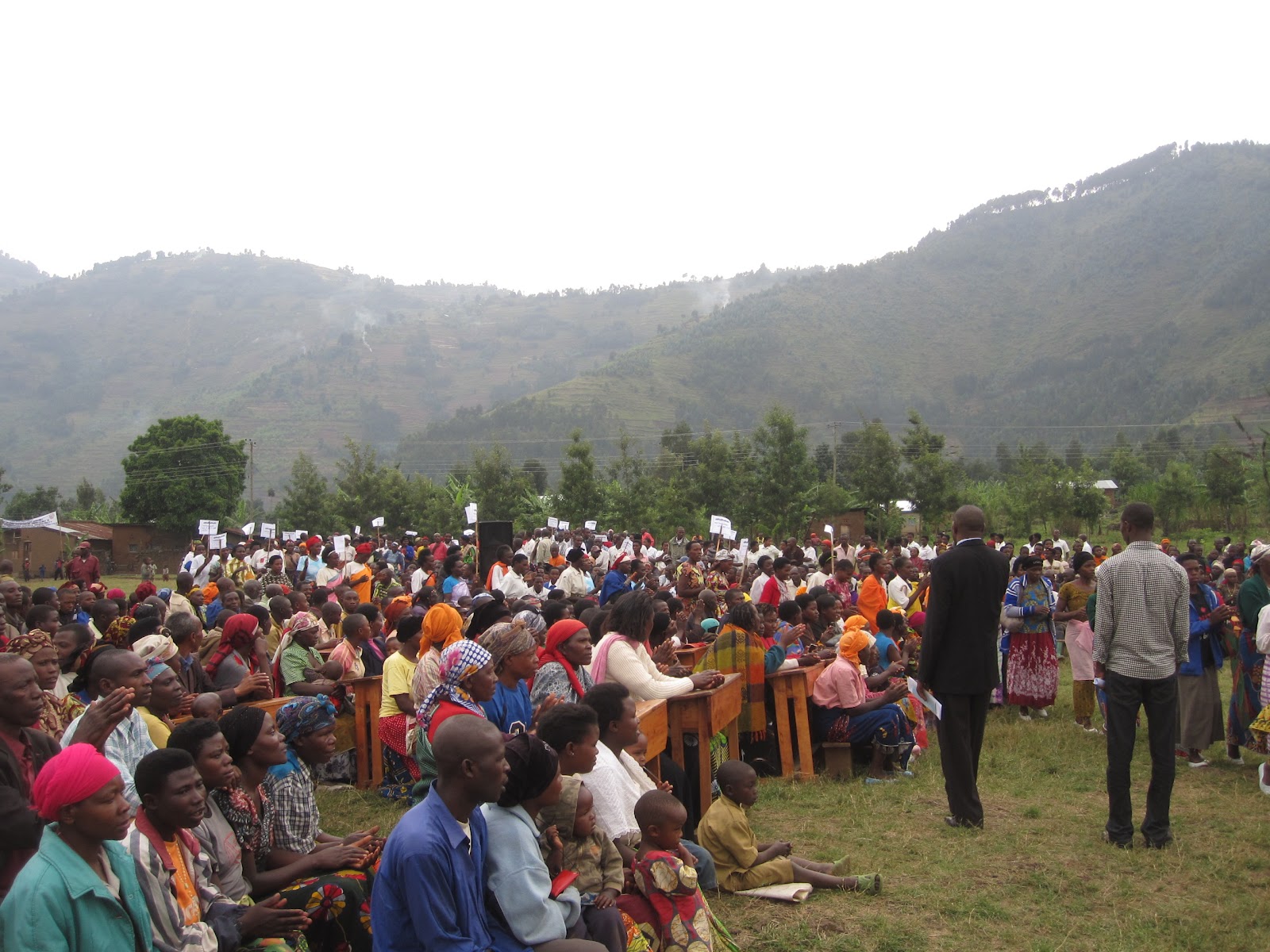
We'll just stop at one village along the way. Getting to one of the villages usually involves moving down a big hill from the main road. This happens to be a celebration of "International Women's Day" from a while back. One of the handful of times I've ventured into a village like this one. 


And back to the road:


And now here’s our destination -- the “big city” of MUSANZE:  


Next stop: to the bus park, then Kigali. Hope you're excited! 

Thursday, April 19, 2012

April

This past week, Rwandans commemorated the 18th anniversary of the genocide which took place in 1994. Every year during this week, everything pauses in Rwanda and there are widespread events to commemorate that time in history. I’m glad I could be here to take part. Without talking too much about the events themselves, I’ll just talk about the thoughts in my head now, post-commemoration.

I have been thinking about one thought more than others: It is so easy to look at things that happen in the world and pause and think, “Oh, how horrible,” and then move on with our lives. We may even do so in a completely genuine and truly heartfelt way. But eventually, after this short pause, we just get on with what we were doing because the truth is, even the most empathetic of us won’t really be affected in any major way after that brief moment of sadness. The thing is, we see the news and especially the books and movies as a sort of story. No matter how true you know something to be, if you were not there, to some extent, it remains a story. Nearly everything I have learned about the genocide has been learned in Rwanda itself. Because I have done my research here, while looking out at Rwandan landscapes, having already met Rwandan people who were affected, I thought that I was in a pretty good position to see the issue as a real event affecting real people. But I’ve realized that after 3 ½ months of being here, I’m only just beginning to grasp the true “realness” of the events. The reason is that I’ve had more opportunities to talk to good friends and people I’m close to, and see that these normal, regular, fun people are the ones who lived through this. They are the ones I read about in the books. Not some sorry people “over there,” but these people who I hang out and joke around with. People who today, on the surface at least, are no different than me.

There is a movie, Sometimes in April, which I believe gives a good depiction of events. One of the things I appreciate about it is that it juxtaposes life in Rwanda with life in the USA at the same time. It not only shows the decisions (or lack thereof) being made by politicians, but it also shows images of ordinary Americans going about their daily business – jogging in the park, playing soccer, etc. I think these are important images because they make you think. For me, it's about being a 5-year-old in that peaceful world, totally unaware that there were people my age in the world, destined to become my friends, who were struggling for their lives and losing their families.

But can we help not knowing, not feeling the full extent of the struggle? Today, I feel I can almost empathize with the people in Rwanda, but it took being here – for a long time – and really getting to know people. Before that, it was not possible to grasp, even though I thought I could. I guess that's reality. 

Monday, February 27, 2012

February

Before the month of February ends, this post is in honor of Black History Month. Recently, the American Embassy opened a new “American Corner” at one of the universities near where I live in the Northern Province. The American Corner is a small library/conference room where anyone can go to read books about the US and other topics, find study resources for standardized tests, and more. Last week I attended the grand opening of the “corner.” In honor of the opening, the embassy sponsored the screening of a movie about the civil rights movement in America.
It was a good movie, but what I found most interesting was the responses of the Rwandese people. Even as I myself watched the movie, I was thinking about parallels between this event in the US and the genocide in Rwanda. Obviously, they were separate events that played out in very different ways, but the idea of ethnic/racial hierarchy that spurred each and the fact that lives were lost over the concept are some things that relate the two. It seemed at the end of the movie that the Rwandese people watching also viewed the movie through this lens.
During the question and answer period, I noticed that the theme was justice. For example, “Was Martin Luther King’s killer found and how was he punished?” and “Was there a special system put in place to penalize the people responsible for murder during the civil rights movement?” After the genocide, it was necessary to put a new “genocide law” in place to deal with the complicated issue of punishing people when so many were guilty at various levels. This is a challenge that Rwanda still faces.
Most touching was the fact that one administrator at the school was moved during the movie to get up and retrieve his guitar. Eighteen years ago, after the genocide and in response to it, he had written a song about embracing love and not hating. Spontaneously, he decided to perform his song (twice) for the crowd. It wasn’t planned but it really seemed to bring closure and cohesion to the event.
No matter where you are, hatred occasionally rears its face. And even though the magnitudes of the civil conflicts that emerge vary greatly, we’ve all had our low points in history. More importantly, we all learn from these low points and move on, however difficult or slowly, towards understanding.

Friday, January 20, 2012

Graduation

Today marked ISAE’s 5th-ever graduation ceremony. 800-something students graduated with either an advanced diploma or bachelor’s degree in the faculties of Agriculture and Rural Development, Agricultural Engineering and Environmental Sciences, and Veterinary Medicine. It turns out I arrived at the perfect time because I got to take part in the ceremony with the teaching faculty, donning a green cap and gown with blue trim to denote my Bachelor’s degree. It brought back memories of my own graduation, not that long ago. In the morning, the faculty gathered and then the procession began. There’s a dirt road that connects the administrative building, the academic buildings, student dorms, and staff housing. It’s a public road where you see a lot of foot traffic by local people most of the time. Walking in lines down that road behind a marching band that came from Kigali for the occasion felt like being in a parade. Towards the end of the procession, as we entered the stadium, I gathered that we were supposed to march in step with the band and I was totally having a marching band flashback. (Except that it was a little harder to march downhill, over rocks, in heels.) This was obviously an exciting event for the community. Many people were lining the roads and children were running alongside the band. While slowly proceeding I had a lot of time to let my mind wander; wearing a cap and gown, marching behind a marching band, looking up at the beautiful rolling hills, and watching people from a different walk of life line the road, I had a moment where I was like, “how did I get here??” It was a little surreal.

The main administrative building at ISAE, with some graduates in the foreground

The ceremony itself was nice. Pretty much what one would expect at a graduation ceremony – similar to a graduation ceremony back home (speeches, calling of names, etc.). One different thing was the incorporation of traditional Rwandan dances. Entertainment breaks are great for keeping spirits up at such long ceremonies – I think American universities should consider it. At this modern graduation ceremony, I was thinking about how here and in many other places the traditional intertwines with the modern so naturally. This goes for clothing as well. You can easily see a person in traditional dress next to someone in “modern” clothing and it’s perfectly natural. This was absolutely true in Oman, as well. I love how people can move with the times while maintaining tradition and culture at the same time.

Me and my next-door neighbor

Finally, this event was a good way for me to meet a lot of people. I feel like it came just at the right time, as I have been here for about a week. Today I was introduced to a lot of great people – particularly some of the younger teachers in their 20s – who I can tell I’ll have a good time getting to know. For all of these reasons, it was a good day!

Wednesday, January 11, 2012

Musanze

I have now arrived at my new home in a place called Busogo. This is in the Northern Province. (There are five provinces in Rwanda – Northern, Western, Southern, Eastern, and Kigali City.) Busogo is part of Musanze district. Musanze is close to both the Uganda and DRC borders. It is famous for two things – its volcanoes and mountain gorillas. This area attracts a decent amount of tourists who come to see these attractions. People seem to be proud of these attractions. Such landmarks as “Lava CafĂ©” can be spotted in Musanze.

The drive from Kigali to here took about two and a half hours and the scenery was beautiful. I had an idea of what it would look like after having visited the part of Uganda that borders Rwanda and my expectations were pretty much fulfilled. This part of the country is characterized by giant rolling green hills. This is a farming economy, so on each hill, there are plots of land carved out for farming and/or terraces built into the hills. Rwanda is nicknamed the “Land of a Thousand Hills” and the whole country is hilly. People even describe their homes based on which hill they live on. When someone described Kigali as “flat,” I laughed. But in comparison to the north, it is comparatively flat.


The university I will work at is called ISAE. (It’s a French acronym but in English it translates to the Higher Institute of Agriculture and Animal Husbandry.) I was a little anxious about arriving on the campus, but I couldn’t have been happier with the welcome. I was introduced to a few people at the university and they were all welcoming and friendly, but not in an overwhelming way. The director of continuing education, with whom I will be working most closely, did a great job of taking me under his wing for the day. We went into town to a few groceries and to start getting to know the place. At night, I was invited to his home for dinner. Also invited were my next door neighbor who is a female animal science teacher and another food science teacher. Over the course of dinner, I found out that this man actually spent the summer of 2007 studying at Cornell! It was funny to hear him talk about the buildings he worked in and lived in and to be able to picture it exactly.

That was Day 1. Day 2 was different because with the director having traveled to Kigali, I was on my own. I woke up and took a long time unpacking and organizing things. I made for breakfast some eggs and bread and butter and brewed a little of the Dunkin’ Donuts coffee which (along with peanut butter) was the luxury food item I decided to bring (even though I’m sure the coffee is great here). I was a little intimidated to leave my apartment. I cooped myself up for most of the day, intimidated by the prospect of going out and calling attention to myself. I admit it was silly, but I had basically decided that it was acceptable to stay in for one day and venture out the next. By 5:00 PM, though, I realized I was being ridiculous and that I should get out and go for a short walk around the compound I live on. I’m so glad I did! This campus is beautiful. Every walkway is lined with flowers. There is a constant red/purple plant interspersed with occasional yellow, red, and blue. The fragrance is the best part. You can see those giant green rolling hills in the distance.


The best thing that happened was that I met another neighbor, a Korean woman whose husband works at ISAE. I met her briefly – enough time for her to invite me for dinner. I had pretty much decided to make a peanut butter sandwich for dinner so I quickly and gladly accepted the offer of a real dinner. We had a very nice time. She has good English (though she doesn’t believe it), but is not fluent. So I got to taste some Korean food. Today, I had lunch with her and her husband and she gave me a tour of the vegetable gardens she keeps. Actually her garden is right outside my door. My Rwandan next door neighbor who I already mentioned is also great and she and the Korean woman are already friends so being with them together feels like being part of a little group.

So things are good so far and I learned a good lesson to take a chance and GO OUTSIDE. I think that comfort zones are only imagined. Something that seems uncomfortable when you think about it can actually prove totally comfortable once you actually do it. That goes for walking out the door as well as coming to Rwanda (and anywhere else) in general.